Chapel Hill
I sent the letter below to CHTC on Sunday, December 4, one day before the meeting, and four days after the public was first notified of the proposed purchase of the property for $7..9 million.
Dear Mayor Hemminger and Council Members:
A common complaint in Chapel Hill is that homeowners bear too great a tax burden because the town lacks a significant commercial tax base to offset it. The town’s onerous development process limits the amount of commercial space that can be built while also limiting the construction of new, different, and denser housing that is affordable to a wider range of people. At the same time, through the Neighborhood Conservation District (NCD) process, the town further restricts the availability of some areas for redevelopment, effectively freezing large areas of Chapel Hill in time. Removing these areas from potential redevelopment results in even less land for the creation of new mixed use and less single-family detached suburban type development to shift the tax burden. If our town is serious about supporting affordability, NCDs are counterproductive, “protecting” large swaths of the town that cannot be developed into denser urban environments.
The Chapel Hill and Carrboro downtowns are vibrant spaces where you can find good food, great music, art, lectures, run into friends and jump on a Chapel Hill Transit bus for free. Some residents have started sharing what they love about our downtowns over on Twitter with the hashtag #loveourdowntowns. Here's a collection of what's been shared so far. Join in on Twitter or share your thoughts on this thread. We'll post another set soon
Town of Chapel Hill Launches Open Data Platform
On Tuesday, July 5, finding data will get easier with the Town of Chapel Hill’s new information service, Chapel Hill Open Data.
Post Date: 07/05/2016 10:57 AM
Where are all of the traffic signals in Chapel Hill? How many bicycle crashes are reported annually in our town? How many police searches were there last year? On Tuesday, July 5, finding this and other data will get easier with the Town of Chapel Hill’s new information service, Chapel Hill Open Data.
With this web-based service, anyone in the community or around the world can access an ever-growing catalog of data sets from Town departments and divisions at www.chapelhillopendata.org. Users can easily create graphs, charts, and maps based on the data sets, as well as download data, interact with it, and reuse it. The site’s goal is to increase government transparency by facilitating public access to local government information.
{Cross Posted from Chapel Hill News}
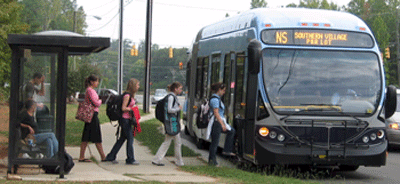
If you boarded a Chapel Hill Transit bus back in February, you might have been greeted by someone with a clipboard asking you to answer a few questions about your ride. The results of this survey were just released and include relevant and interesting findings as we think about the future of transit in our community.
These survey data tell us quite a bit about who rides Chapel Hill Transit. Most riders (88 percent) were somehow affiliated with UNC, and 93 percent of those surveyed were taking the bus to get to college or work. A majority (68 percent) ride the bus five days a week while another 21 percent use it three or four days a week.
{Cross posted from the Chapel Hill News}
A picture of a stop sign graffitied to read “STOP PROGRESS” appeared on Twitter last week. The person who Tweeted it captioned it simply: “Chapel Hill politics in a nutshell.”
A few days later, a community leader expressed to one of us their disappointment in how our community is perceived. “People used to look to us as a leader in innovative policies, a place where cool things were happening. That doesn’t happen anymore.”
How we got to this point is no mystery. Past local elected officials enacted policies that made it difficult to open new businesses and build new kinds of housing. As a result, most development of the past few decades has been low-density, single-family homes on dead-end streets.
[Cross-posted from the Chapel Hill News]
We’re fortunate to live in a community with many resources and services. That’s a large part of what makes southern Orange County so appealing to newcomers, and so hard for natives and Carolina graduates to leave.
But our community isn’t perfect. We don’t have it all. The way we live is changing, and so our community and the things we want to see in it have to change, too. How we currently live and how people will live in 50 years are sure to be different. It’s important that we keep this evolution in mind in making decisions now that shape our community later.
We should start today to identify what’s missing in our community. For example, community conversations have already identified a desire for things like an arts district, more robust public transit options, more green space, housing options that are affordable for everyone, retail choices that don’t require driving to Durham, and commercial space to support microenterprises and makers.
The talking-at-elected-officials-at-podiums-at-7-p.m. model isn’t working for the great majority of residents in our community. This method excludes too many people, and it privileges those who can spend many hours participating in lengthy meetings.
Pages
Community Guidelines
By using this site, you agree to our community guidelines. Inappropriate or disruptive behavior will result in moderation or eviction.
Zircon - This is a contributing Drupal Theme
Design by
WeebPal.